
Beyond the Tipping Point: Modernization Is Moving Across the Entire Ecosystem
The whole industry is moving in the same direction. Whether anyone is watching or not.

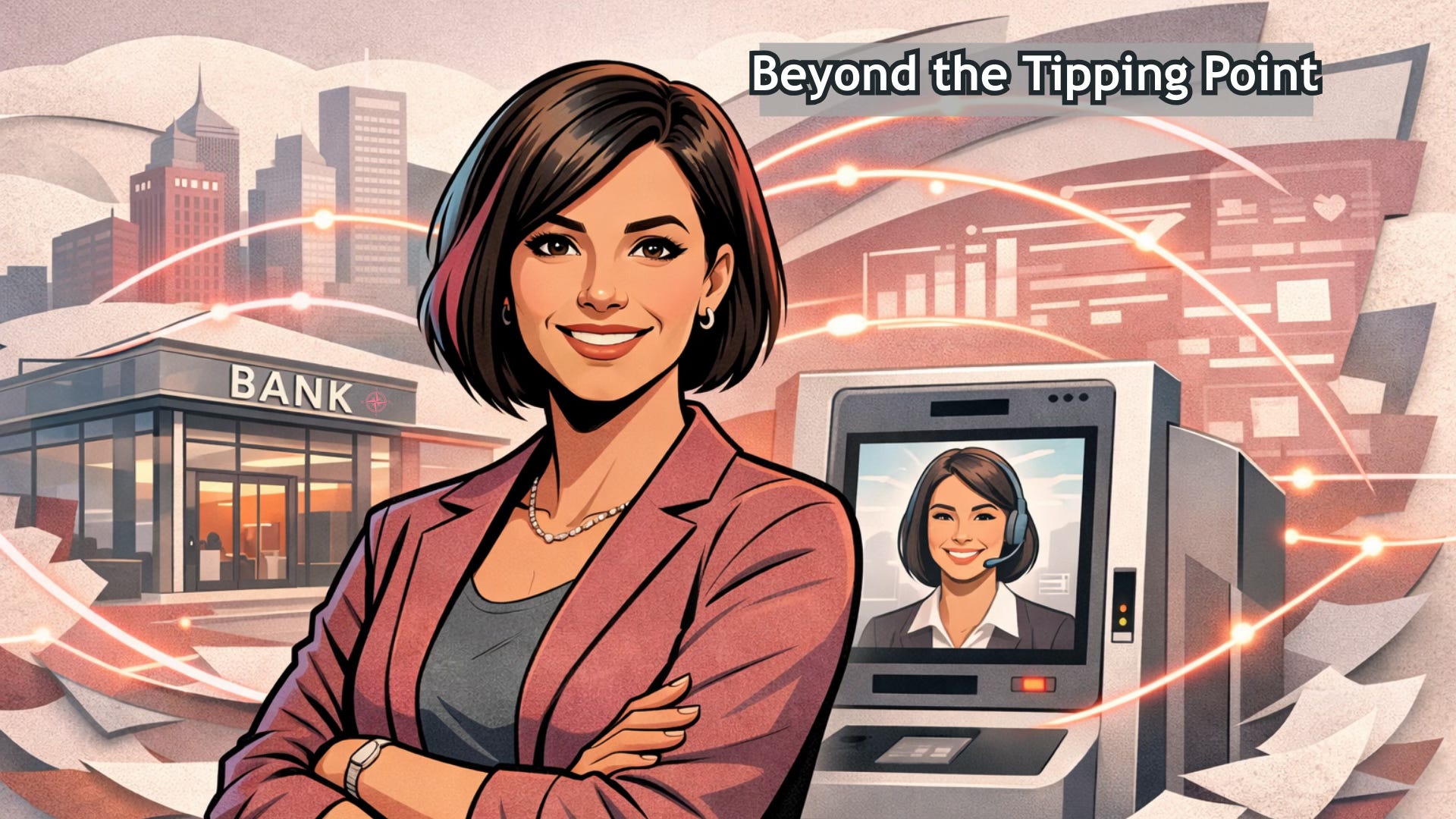
“JPMorgan Chase targets 160 branch openings this year” …. “Bank of America to open 150 locations through 2027”… are headlines we’ve seen recently.
Digital Has Owned the Spotlight
For the past decade, the industry conversation has been focused primarily in one direction.
Digital.
Mobile banking.
Neobanks.
Embedded finance.
APIs.
AI.
ISO 20022.
Stablecoins.
Fintech disruption.
Panels multiplied. Articles piled up. Leadership teams invested serious energy trying to decode what the new competitive landscape meant for their institution.
The digital transformation of financial services is real. It is significant. And it is far from finished.
But branches are transforming too.
The same principles reshaping digital banking are showing up in physical locations.
Unified experiences.
Seamless handoffs.
Reduced friction for both customer and employee.
Lower cost to serve.
Access to communities that were previously too expensive to reach.
Recently, I spoke with a colleague working on branch transformation. What he described was not just a branch story. It was a story about the same architectural reckoning happening in a part of the industry that most payments leaders are not watching closely.
That is exactly why it matters.
The Same Principles, Showing Up Everywhere
Not long ago, the average bank teller was navigating five, six, sometimes eight different systems to serve a single customer.
Different logins.
Different interfaces.
Different rules.
Cycling between screens while the customer waited.
Operational costs running three to five dollars per interaction.
High turnover among younger staff who grew up with intuitive technology and could not reconcile legacy friction with modern expectations.
Branches closed on weekends.
Rural communities underserved because the cost model made expansion unsustainable.
Sound familiar?
It should.
That description mirrors the fragmented, siloed architecture many payments teams are still working through today.
What is changing in branches is not a single technology purchase.
It is a decision to rebuild the operating model around a new reality.
Tellers moving to a unified interface covering account management, transactions, loan origination, and customer history.
Branches extending hours.
Cost per interaction dropping materially.
Interactive teller machines bridging physical presence with remote expertise.
Remote expertise layered into physical presence.
The result is not just efficiency.
It is reach.
The principles behind that transformation are not “branch principles.”
They are industry principles:
Design around the customer.
Design around the operator.
Eliminate friction.
Build governance before scale.
Those same principles apply directly to payments modernization.
The ecosystem is not moving in multiple directions.
It is converging.
Branches are demonstrating what disciplined modernization looks like in motion.
The Parallel to Payments Is Not Subtle
I am not a branch expert.
But modernization patterns reveal trajectory.
Across the industry, I am watching experienced leaders hesitate at the edge of instant payments send adoption.
Not because the rails are unproven.
Not because the technology fails.
Not because new categories of risk appeared overnight.
The hesitation exists because most institutional architecture and processes were not designed to operate at real-time speed.
That is not a payments-specific problem.
It is the same challenge branches and call centers face.
Systems built for a different era.
Operating at a different cadence.
Serving customers in ways that no longer align with expectations.
Instant payments do not create risk because money moves faster. Risk shows up when the institutions do not design for speed.
That is a structural issue. Not situational.
The risks are not mysterious.
They resemble risks banks manage every day.
What is often missing is the governance layer that makes speed sustainable.
Governance Is What Makes Speed Possible
Branch modernization is not simply the result of new software.
It is the result of leadership asking better questions:
What does the customer need?
What does the frontline employee need to serve confidently?
What controls must exist before scale?
Those are governance questions.
Instant payments send requires the same shift.
Settlement, authentication, fraud exposure, and economics considerations do not change because money can move in seconds.
They become more visible.
Controls already exist for ACH, wires, and cards. They need to be extended, layered, and orchestrated for an environment operating continuously.
That is not an excuse to wait.
It is a reason to design deliberately.
The Ecosystem Is Not Waiting
It is not just online banking experience that is transforming.
It is every touchpoint where money and trust intersect:
Branches.
Contact centers.
Digital onboarding.
Payments.
The destination across domains is consistent:
Unified experiences.
Architecture that serves the customer and the operator.
Friction removed, not shifted.
Branches are evolving.
Digital channels are evolving.
Payments is the next visible chapter.
Institutions that have activated instant payments send are not reckless.
They are prepared.
They asked the governance questions first.
They designed control into the flow.
They built before they scaled.
That is not bravery.
It is operating discipline.
The Leadership Question
The branch that was closed on weekends was not because leadership did not care about customers.
It closed because the architecture made it too expensive to stay open.
The rural customer who drives forty minutes to a branch does not do so because the institution lacks empathy.
They do so because the system was not designed to reach them.
Modernization changes that.
Right now, businesses are waiting on disbursements.
Consumers need access to funds and will pay competitors to get it.
Entire market segments become reachable when instant payments send is live and governed.
The question is not whether instant payments is coming.
It is already here.
The question is whether your institution is structured to deliver it confidently, or whether legacy friction is still embedded in the experience
In a world where money moves instantly, leadership is not about moving faster.
It is about being prepared.
Branch modernization is unfolding in stages, with governance embedded as capabilities expand.
Institutions that move are not just reducing cost per transaction.
They are expanding reach.
Improving resilience.
Strengthening their relationship with customers.
That is what governed instant payments makes possible.
Not just faster money.
A stronger institution.
We are past the tipping point.
The ecosystem is aligned.
The whole industry is moving in the same direction.
Payments is not the exception.
It is the next chapter.
And if you want weekly analysis on governed instant velocity, payments modernization, and control architecture, subscribe to The Instant Edge.
If you are hosting an executive forum, board strategy session, or industry event and want this conversation brought to the room with clarity and energy, I welcome the discussion.